Written by Ben Young Landis for depositar lab / Research Data Management Hub
Without context and curation, field data and museum data are just disconnected, inconsistent, and potentially incorrect fragments of information. And with the expansion of research projects and study sites and study subjects — multiplied by years upon decades of continuous long-term monitoring efforts and collections efforts — research data management (RDM) are essential services that any scientific discipline or national academy must invest in.
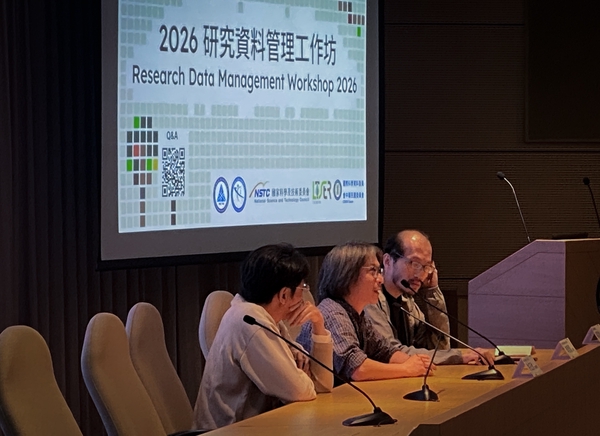
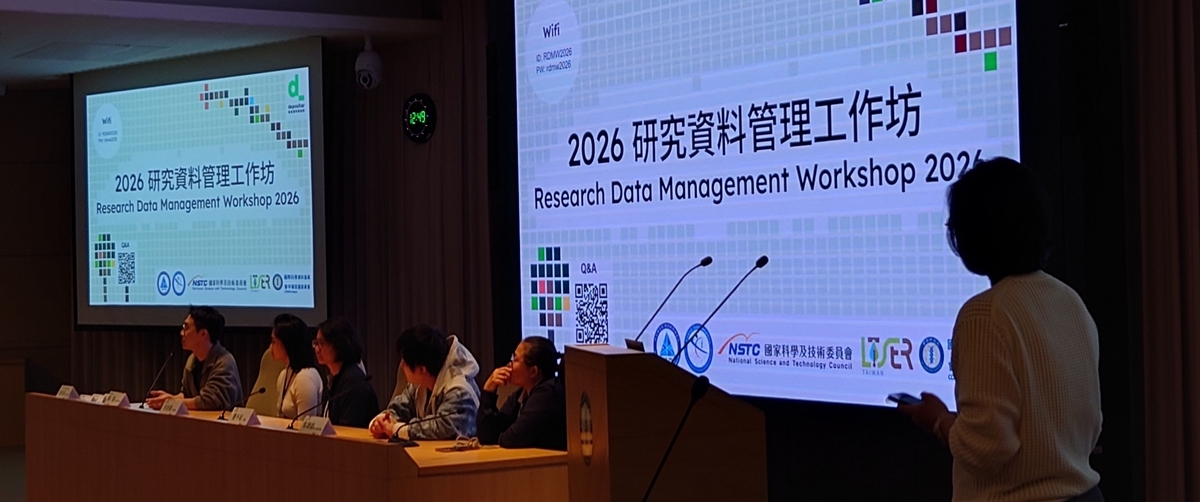
Taiwan’s leading research institutions are creating this RDM network and collaborative workflow to leverage its ecological and sociological monitoring data for global multidisciplinary collaboration. Showcasing these best practices and case studies was the goal of the Research Data Management Workshop 2026 (RDMW2026), held on March 26 at Academia Sinica in Taipei.
RDM2026 was organized by the depositar lab, the data infrastructure research and services team in Taiwan led by Tyng-Ruey Chuang 莊庭瑞, Cheng-Jen Lee 李承錱, and Chia-Hsun Wang 王家薰. Ling-Jyh Chen 陳伶志, director of the Academia Sinica Department of Information Technology Services and the Taiwan committee chair for CODATA, provided the welcoming remarks.
Persistent Identifiers: Tracking the Life Cycle of Research#
Scientific research creates a diversity of ideas, outputs, and outcomes throughout its life cycle — individual specimens, field measurements, analysis results, published manuscripts, and more. But how to label and track these unique quanta of information, differentiating them and making them more discoverable by researchers and the public?
Persistent identifiers (PIDs) can provide this searchable taxonomic structure for RDM — and Tokyo-based independent scholar Rorie Edmunds opened the keynotes portion of RDMW2026 with a primer on PIDs. Edmunds mentioned Digital Object Identifiers (DOIs) for publications and ORCID for individual researchers as examples of widely adopted systems; and consortiums like IGSN, ePIC, and DataCite among those creating and implementing these systems for everything from geosciences specimens to analytical instruments.
There is one underdeveloped category of PIDs: the project level. Edmunds explained how the Research Activity Identifiers (RAiD) effort is creating PIDs for individual projects. RAiDs could then serve as the central cog connecting PIDs for all the people, objects, papers, grants, linked across a research life cycle — forming a PID map, even.
Enforcing the adoption of PIDs requires commitment, especially as projects grow and as more objects become interlinked. “Creating and maintaining PIDs and PID metadata takes time and work, but is ultimately worth it,” said Edmunds. He cited an Australian analysis where wasted time from rekeying metadata about grants, publications, and projects amounted to nearly AUD$24 million and 38,000 person days lost per year.
Edmunds concluded with an even more stark reminder for the RDMW2026 audience: Not enough researchers in Taiwan are taking advantage of PIDs. Only 41 organizations in Taiwan are members registering DOIs for journal articles, he said, and only one university is a DataCite member. “Taiwanese researchers are mostly missing out on increased discoverability and credit for their work,” warned Edmunds.
Taiwan: A Living Laboratory for Ecological and Sociological Research#
Taiwan’s natural and cultural geography presents unique opportunities and challenges for researchers, other keynote speakers reminded the RDMW2026 audience.
One example is Taiwan’s widespread mountain cloud zones. Choy Huang 黃倬英 from the National Taiwan University (NTU) Department of Geography discussed long-term monitoring challenges for this ecoregion, where cloud forests and tea farms alike are enriched by the everpresent fog. These sites often require long drives and difficult hikes to access, and researchers have difficulty recruiting volunteer teams; have to contend with wildlife and human interference with field instruments; and must reconcile modern data with generations of land use records, including those from Japanese colonial period and traditional Indigenous use.
Respecting the Indigenous data sovereignty of Taiwan’s diverse first peoples is a critical perspective for Taiwan — which is still falling short in many ways — explained Umin • Itei Tanohila 日宏煜 from the National Dong Hwa University (NDHU) Department of Indigenous Development and Social Work. Opening his talk with a land acknowledgement of the Ketagalan peoples ancestral to Taipei as well as greetings of gratitude in the Saisiyat language, Umin went on to explain how data collection by outsiders presents complications for Taiwan’s Indigenous communities, who can even be suspicious of the word “survey” due to decades of government oppression of Indigenous peoples. And whose data would it be? How is permission given and respected for this traditional biodiversity knowledge over subsequent data access and use? Like other regions around the world with difficult colonizer histories, any research in Taiwan should find ways to apply Indigenous data governance principles. Umin, whose own heritage is Saisiyat, mentioned some of these solutions are dependent on changes to Taiwan government’s legal framework — a process frustratingly distant for the Indigenous communities affected and researchers in the field.
Taiwan’s multitude of coastal urban areas also present ample needs for long-term monitoring. Su-Fen Wang 王素芬 from the National Changhua University (NCUE) Education Department of Geography showcased examples from Changhua County. Ecologically, Changhua faces water pollution, subsidence, and habitat degradation, all impacting its mangrove and other wetland ecosystems. Sociologically, Changhua is facing losses in economic power and an aging demographic. Combine all this with historic shellfish mariculture trades, influx of migrant labor, and installation of solar and wind renewables generation, researchers have their hands full conducting detailed field monitoring of environmental quality — as well as field interviews and questionnaires assessing public attitudes towards these community changes.
LTSER: Taiwan’s Nationwide Research Monitoring Network#
Managing these ecological and sociological surveys is the work of the LTSER Changhua Station — one of six stations that make up Taiwan’s Long-Term Socio-Ecological Research (LTSER) platform, which is funded by Taiwan’s National Science and Technology Council (NSTC).
Besides their critical mission to capture a holistic, interlinked view of Taiwan’s socio-ecological systems, these six LTSER stations also provide ample training opportunities for Taiwan’s scientific teams. A full segment of the RDMW2026 agenda gave the floor to research data managers to present highlights from their stations: Jing-Ying Wu 吳靖穎, postdoctoral researcher at National Sun Yat-Sen University (NSYSU) Department of Oceanography, and King Tsao 曹千祐, doctoral student at NTU Graduate Institute of Networking and Multimedia, presented on the LTSER Southwest Coast Station. Chia-Ling Lu 呂佳陵, research assistant at the NDHU Department of Natural Resources and Environmental Studies, presented on the LTSER Hualien Station. Wei Lin 林薇, a research project specialist also at the NTU Department of Geography, presented on the LTSER Feitsui Station.
Although they track vastly different systems — Feitsui 翡翠 a major reservoir basin serving Taipei and Chhit-Kó 七股 a rural coastal economy in the southwest, for example — the shared challenge of all LTSER stations is preparing all of these monitoring records under interoperable data management planning. Every dataset from HOBO water loggers to camera traps to community surveys have to be meticulously labeled with their metadata and prepared for upload to local and domain disciplinary data repositories — including the depositar, itself a public repository for research data. And each step aspiring to the FAIR data management principles of making these records findable, accessible, interoperable, reusable.
A.I. agents, natural language processing, and other automation tools can help with these tedious tasks. Jhu-Jyun Jhang 張筑竣, a developer at the Academia Sinica Biodiversity Research Center (BRCAS), discussed how ecological data in particular needs to play with domain disciplinary repositories such as Taiwan Biodiversity Information Facility (TaiBIF) as well as international counterparts. Darwin Core provides a standards framework for biological diversity data — so the same parameters of organization can be expected for data from Taiwan or Brazil or the United States, for example.
The “S” For Sociological Is Essential#
The need to analyze ecological outcomes and sociological outcomes in concert, to diagnose a thriving or ailing community, makes long-term monitoring an inherently multidisciplinary exercise.
That’s why the “S” in “LTSER” is essential, as emphasized by the next pair of speakers on the RDMW2026 agenda. Mei-Hua Yuan 袁美華 from the Academia Sinica Research Center for Environmental Changes described the special circumstances at LTSER Lyudao Station. Located off southeastern Taiwan, Lyudao 綠島 or Green Island is barely one-fourth the size of Manhattan Island, New York. During Taiwan’s White Terror period, it was a penal colony for jailing political prisoners — but today, it is a tourism destination for snorkeling and diving.
Lyudao offers a special place to apply the DPSIR (Driver, Pressure, State, Impact, Response) framework to systematically study how government policies, community livelihoods, and ecosystem services all interact. But the island’s complicated history creates many sensitivities; even adhering to IRB (Institutional Review Board) standards for interview research, some respondents are simply hesitant towards interview transcription, for example.
This duty of care was emphasized by digital anthropologist Mei-Chun Lee 李梅君 from the Academia Sinica Institute of Ethnology. As sociological field work moves beyond the physical village to virtual spaces and digital chatrooms, and beyond notebooks and audio tapes to cloud drives, GitHub, and large language models, researchers must be even more aware of any power asymmetry between themselves and their subjects, Lee Mei-Chun cautioned.
“Field work, then, is the care work sustained by continuous acts of caring and being cared for,” she added. Even data management steps as innocent as creating backups or using A.I. transcription and translation can unintentionally open doors for unauthorized users. Caring for data, then, is essential to RDM best practices.
Curating Taiwan’s Data for Meaningful Use and Global Collaboration#
The concluding segment of RDMW2026 brought the conversation back to its roots in museum curation.
Fu-Chun Yang 楊富鈞, from the National Taiwan Museum (NTM) Collections Management Department, titled his talk “Naming the ‘Chaos’: Deconstructing Name Management Patterns in Natural History Collections” — and proceeded to list the classic headaches of managing natural history collections. From “N/A” and empty fields in old labels for old specimens; changes to species taxonomic status over time or simply misspelled names; and the real limitations of people power in rectifying these errors and conforming to digital data standards.
Data managers must solve these inconsistencies when digitizing collections records and automating fixes — and make sure local databases are interoperable with global facilitation efforts at open data. Szu-Hsien Lee 李思賢, another developer at BRCAS, traced Taiwan’s efforts back to the creation of the Global Biodiversity Information Facility (GBIF) in 2001. Taiwan’s memorandum of understanding with GBIF would pave the way for TaiBIF, the Taiwan Biodiversity Information Facility.
Today, maintaining natural history collections standards across disparate databases is the shared responsibility of the members of TBIA, the Taiwan Biodiversity Information Alliance. To get these databases in sync, Szu-Hsien Lee advocates for multi-tenancy data management architecture. Efforts have been under way at the Academica Sinica’s Biodiversity Research Museum Herbarium and zoological specimens collection, Taiwan Barcode of Life cryobank, and Provincial Pingtung Institute, leveraging the Archival Resource Keys (ARK) framework to create specimen PIDs and publishing to NatureDB.
The final talk of RDMW2026 was the most unexpected but no less enlightening. Cheng-Hsin Hsu 許正欣 from the Academia Sinica Center for Digital Cultures provided an overview of the Taiwan Movie Database (TWMDb).
A collaboration between the Center for Digital Cultures and the Taiwan Film and Audiovisual Institute (TFAI), TWMDb advances digital archeology by making historic images and film available for research. The parallels with long-term ecological and sociological research datasets were soon clear: curating motion picture archives also requires standardizing information troves with geolocation, provenance, authorship, and other metadata labels. That might include where a news reel was filmed or where a movie was screened; the individual cinemas themselves as datapoints; artifacts associated with films such as posters and playbills; and cast and crew information.
Cheng-Hsin Hsu says the information can help recreate a Taiwan film culture map that can move backwards and forwards in time, plus relational search tools connecting objects, people, and events. Indeed, just as Taiwan researchers are racing to document socio-ecological changes and biodiversity losses, conserving Taiwan’s film media history requires similar urgency. Whether it’s daylighting news reels from Taiwan’s authoritarian era, capturing lost examples of Tâi-gí language performances across colonial periods, or mapping out Taiwan’s once-plentiful and iconic local movie theaters, film archeologists must juggle the object-centered tasks of preservation and cataloging with the knowledge-centered tasks of reconstructing and interpreting historical context.
Taiwan Across Time and Space#
Beginning as the Open Data Workshop in 2013, RDMW2026 is the tenth edition of this meeting of data collection developers, field researchers, museum managers, and everyone else in between who collect, shape, and share data for research. To the disappointment of some guests, the 2026 program was entirely lecture-focused, lacking actual hands-on sessions led by data managers; informal networking time was also mostly limited to the lunch hour. Still, the one-day event showcased the diversity of use cases and ongoing partnerships across Taiwanese research institutions.
As data management strategies, technologies, and standards advance, so too must interdisciplinary conversations continue between data collectors, managers, and end users. The 2026 Research Data Management Workshop provided a snapshot of how Taiwan’s research data management efforts are remaining in step with global standards — to the benefit of making Taiwan’s data searchable and available to international collaborators — but also for Taiwan’s academicians to better investigate, understand, and communicate the patterns of change in our own natural and cultural heritage.
Institutions referenced in this story (by English alphabetical order)#
- Academia Sinica 中央研究院
- Academia Sinica Biodiversity Research Center (BRCAS) 中央研究院 生物多樣性研究中心
- Academia Sinica Center for Digital Cultures 中央研究院 數位文化中心
- Academia Sinica Department of Information Technology Services 中央研究院 資訊服務處
- Academia Sinica Institute of Ethnology 中央研究院 民族學研究所
- Academia Sinica Research Center for Environmental Changes 中央研究院 環境變遷研究中心
- depositar lab 研究資料寄存所實驗室
- National Changhua University (NCUE) Education Department of Geography 國立彰化師範大學 地理學系
- National Dong Hwa University (NDHU) Department of Indigenous Development and Social Work 國立東華大學 民族發展與社會工作學系
- NDHU Department of Natural Resources and Environmental Studies 國立東華大學 自然資源與環境學系
- National Sun Yat-Sen University (NSYSU) Department of Oceanography 國立中山大學 海洋科學系
- National Taiwan Museum (NTM) Collections Management Department 國立臺灣博物館 典藏管理組
- National Taiwan University (NTU) Department of Geography 國立臺灣大學 地理環境資源學系
- NTU Graduate Institute of Networking and Multimedia 國立台灣大學 網路資訊與多媒體研究所
- Research Data Management Workshop 2026 研究資料管理工作坊
- Taiwan Biodiversity Information Alliance (TBIA) 臺灣生物多樣性資訊聯盟
- Taiwan Biodiversity Information Facility 臺灣生物多樣性資訊機構 (TaiBIF)
- Taiwan Committee for CODATA 國際科學資料委員會中華民國委員會
- Taiwan Film and Audiovisual Institute (TFAI) 國家電影及視聽文化中心
- Taiwan LTSER 臺灣長期社會生態核心觀測站規劃辦公室